Tuesday, July 26, 2022

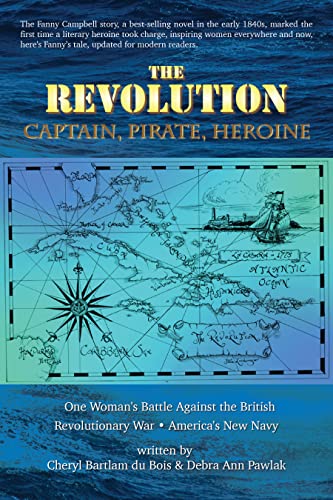
At Long Last Our New Book Has Arrived! The Revolution: Captain, Pirate, Heroine


As the American Colonies prepare for a revolution, young Fanny Campbell, a fisherman's daughter from Lynn, Massachusetts, yearns for adventure.  When her intended ends up in La Cabana, an infamous Cuban prison, she will do anything to save him.  Fanny dons men's clothes and takes to the sea where she incites a crew to mutiny, battles hardened pirates, and clashes with the King's Royal Navy.

In the mid-1840s, a best-selling novel, 'Fanny Campbell, The Female Pirate Captain: A Tale of The Revolution' written by Maturin Murray Ballou took the country by storm. It sold more than 75,000 copies for a quarter each and marked the first time that a book centered on a literary heroine who took charge of her own life. Fanny Campbell inspired many girls of the Nineteenth Century including Michigan's own Sarah Emma Edmonds who, at the onset of the Civil War, disguised herself as a man and joined the Union Army. Likewise, Maud Buckley, the widow of a sea captain, was also stirred enough to get her own captain's license and sail the Great Lakes in the 1870s on her very own schooner, which she christened The Fanny Campbell.

Now it's time for a new generation to hear Fanny's story retold for the modern reader and be inspired by her bravado and daring. In our second book that we have coauthored, Cheryl Bartlam Du Bois and I have once again brought to life a heroine for the ages. 

Fanny Campbell found herself in the midst of a revolution when the British Colonies in the new world revolted against the Crown. Witnessing such rebellious activity as the Boston Tea Party and living with severe restrictions due to the ban of all things English, she fell in love during perilous times. When her intended was captured and imprisoned in Cuba, she took to the high seas, disguised as a man, named Bartholomew Channing, and commandeered a British brig to rescue her lover. Fighting, Pirates, rough waters, and English enemies, they were reunited and together they commandeered two more British merchant vessels and sent a notorious Pirate ship full of buccaneers into eternity. The captured British ships and their spoils were ultimately given to General Washington and proved invaluable during the Revolutionary War.

Set amid actual events such as the Battle of Lexington and Concord with real heroes of the past like Moll Pitcher, the famed Psychic of Lynn, Fanny’s story unfolds within a colorful period of American history and is sure to please history buffs and armchair adventurers, as well as inspire a new generation of women to meet any challenge head on.  

Get your copy now:

Amazon.com: The Revolution: 9780974541440: Du Bois, Cheryl Bartlam, Pawlak, Debra Ann: Books


Tuesday, April 7, 2020

Al Kaline - #6


It has been a long while since I posted anything here, but the passing of Detroit Tiger great, Al Kaline, has inspired me. He began his career in the Motor City in 1953 at the tender age of 18—right out of high school.  He never once played in the minors, but wore that old English D until he retired in 1974.  

As a kid, my grandpa took me to Tiger Stadium on the corner of Michigan Avenue and Trumbull in the middle of Detroit, where we cheered for our favorite boys of summer—just the two of us.  Never mind that I was the only one in the family who would go with him.  You see, he believed in getting his money’s worth so we always attended double headers, but first we had to watch batting practice.  We would get to the park between 11-11:30 am on game day. The first game began around 1:00 and the second game followed after a short break.  Grandpa fed me all day long—popcorn, peanuts, hotdogs, ice cream.  You name it.  I ate it.


Kaline is a vivid part of those memories.  His major league record speaks for itself (3,097 hits, 399 homeruns, and 1,582 runs batted in, just for starters).  He was the Tiger you could always count on--the dependable Right Fielder or the hard-working First Baseman and then came the 1968 World Series against the St. Louis Cardinals.  Now that was baseball! Denny McClain! Bill Freehan! Willie Horton! What a team!  I still smile when I think about them.  


Kaline was inducted into the Baseball Hall of Fame in 1988--a well-deserved honor.  He remained with the Tigers and became an excellent announcer for the game.  He was a kind and quiet man who wore the #6 and it was only right that he passed away on the 6th day of April.  Mr. Kaline, you leave behind a wonderful legacy that will continue to inspire those of us who were lucky enough to see you play.  And if you run into my grandpa somewhere up there, make sure you say ‘hello’ and ask him about those double-headers he loved to watch—after baseball practice, of course!  


Tuesday, July 3, 2018

Ten Things You Might Not Know About 'Yankee Doodle Dandy' (1942)


In honor of the Fourth of July, here are some fun facts concerning the classic musical ‘Yankee Doodle Dandy’ (1942)!


1)      George M. Cohan wanted Fred Astaire to play him in the film, but Astaire’s ballroom style of dancing style was too different from Cohan’s stiffer legwork and Cagney got the part.


2)      Rosemary DeCamp played Cohan’s mother, but in reality she was more than a decade younger than Cagney.


3)      Cohan’s sister, Josie, was played by Cagney’s real-life sister, Jeanne, while Cagney’s brother, Bill was a producer on the film.


4)      The film was scheduled for a July 4, 1942 release, but in deference to Cohan’s failing health, it premiered in New York, New York on May 29, 1942.


5)      Cagney won his only Oscar for his work in this film, but the movie itself lost out to ‘Mrs. Miniver’ (1942) for Best Picture.


6)      Cohan’s choreographer, Johnny Boyle, worked closely with Cagney on the dance routines.


7)      Cohan was actually married twice, but in the movie he had only one wife, Mary.


8)      Actress Joan Leslie was only 17 and still in high school when she played the part of Cohan’s wife.


9)      Despite its patriotic flair, the film was already in production when Pearl Harbor was attacked on December 7, 1941.


10)   Josie Cohan was married to MGM director and Academy founder Fred Niblo.


Monday, April 16, 2018

Ten Things You Might Not Know About 'I Love Lucy'


These fun facts might surprise you!

1)      The name ‘Fred’ Mertz was given to the character played by William Frawley as a nod to Lucille Ball’s real life brother, Fred.

2)      ‘I Love Lucy’ began as a radio show called ‘My Favorite Husband’ featuring Lucille Ball and Richard Denning as her spouse.  When the show transitioned to early television, Ball insisted that her husband, Desi Arnaz, be given the role.  Denning was out and Arnaz was in.

3)      Unsure whether she should take the plunge from movies to television, Ball had a dream about her good friend comedienne Carole Lombard who had perished in a plane crash almost a decade earlier. Lombard told Ball to take a chance and so she did.

4)      When selling the show to Philip Morris, Ball and Arnaz were told that Desi’s orchestra could only be used when they were an important part of the plot.  Arnaz was concerned about his ‘boys’ and explained that they had to be paid on a weekly basis whether they were in front of the camera or not.  The sponsors agreed. 

5)      As part of their negotiations with CBS, Arnaz asked if he and Lucy could own 100% of the shows.  Much to their surprise, the network agreed.

6)      Arnaz’s Cuban accent always got a laugh—whether he meant to or not.  Someone once hung a sign on his dressing room door that read:  “English broken here.”

7)      As CBS prepared for the show’s second season, the network provided Arnaz with a new budget.  Going over the numbers, the business-savvy actor noticed an extra million dollars.  The very next day, he took the paperwork back to CBS informing them of their error.  He was told to stick to his acting and leave the numbers to them.  He immediately spread out the paperwork and pointed out the problem.  The CBS brass suddenly had a newfound respect for the Cuban bandleader.

8)      Lucy and Desi tried to keep her second pregnancy under wraps for as long as they could. However, when Louella Parsons found out about it, she broke the news in her gossip column and at the same time apologized to the couple for her betrayal.  She then went on to explain that keeping such important news from her readers would be a disservice to them.

9)      William Frawley was a huge baseball fan and he had a clause in his contract stipulating that if his favorite team, The New York Yankees, made it to the World Series, he would be allowed time off to attend the games.   It happened four times during the show’s six-year run causing Frawley to be written out of the script more than once.

10) In 1953, Ethel Mertz was given a middle name of 'Louise'; 3 months later, the writers rechristened her Ethel 'Roberta' (Vance's real middle name, by the way); one year later, she was referred to as Ethel 'Mae'. I guess they couldn't make up their mind, but if anyone is checking, Fred's middle name was 'Hobart'--and that never changed.


Monday, March 26, 2018

Ten Things You Might Not Know About 'The Honeymooners'!!


What can you add to the list???  Put it in the comments below. 

1)    When Jackie Gleason met Audrey Meadows for the first time, he thought she was all wrong for the part of Alice Kramden—she was too pretty, too young and much too charming.  So Meadows went home and had several pictures taken in her apartment wearing old clothes and curlers sans make-up.  When shown the pictures, Gleason didn’t even recognize her, but exclaimed:  “That’s our Alice! Who is she?”

2)      ‘The Honeymooners’ was broadcast from New York City at Studio 50 on 53rd Street and Broadway.  ‘The Ed Sullivan Show’ also aired from Studio 50 and the place has since been renamed ‘The Ed Sullivan Theater’, where David Letterman worked for many years.  It is now on the National Register of Historic Places.

3)      ‘The Honeymooners’ originally began as a small segment of ‘The Jackie Gleason Show’, which first aired in 1952.  Brooklyn bus driver Ralph Kramden became so popular that three years later, Gleason stopped filming his variety show and began the half-hour situation comedy—and those are the 39 episodes seen most often.

4)      The first Alice Kramden was played by Pert Kelton who was blacklisted during the Red Scare and let go by the network.  In deference to the actress, Gleason told his team that Kelton was ill.

5)      Prior to one show, Meadows had an allergic reaction to some shrimp—her eye swelled up.  Gleason, ever the improviser, wrote four lines of dialogue to cover the problem:


                                        Trixie:  What happened to your eye?

                                        Alice: I forgot to do the laundry.

                                        Trixie:  So?

                                        Alice:  Ralph threw his socks at me.   


6)      As the show grew more and more popular on Saturday nights, the fan mail increased.  Letters poured in from all over the country with fans enclosing hundreds of kitchen curtains and aprons hoping to cheer up Alice who was stuck in that dingy apartment.  One woman even enclosed a dime instructing Alice to buy a new curtain rod as it would be too cumbersome to send in the mail.

7)      The Kramdens lived at 328 Chauncey Street in Bensonhurst, a borough of Brooklyn.  Growing up, Gleason also lived in an apartment on Chauncey Street, but in Brooklyn’s Bushwick area—a poor section of town. He modeled the Kramdens’ apartment after his own boyhood residence.

8)      After each performance, Gleason sent one dozen roses to every woman appearing in the show.

9)      Audrey Meadows always wore flats when playing Alice Kramden so she would appear shorter than her onscreen husband.  She was five foot six to Gleason’s five foot nine.

10)   Art Carney claimed that his dramatic hand gestures were based upon his own father’s hand motions whenever the senior Carney had to sign one of his son’s bad report cards.


Friday, April 14, 2017

Half Horse, Half Hollywood

Born in a small coal mining village known as West Stanley in Durham County, England, early filmmaker David Horsley was the son of a master mechanic and blacksmith who worked for the West Stanley Coal Company.  The town was owned by the coal company.  Most of the residents were miners and their homes were also owned by their employer.  The dwellings were simple and most families owned at least one pig.  The Horsleys were no different and on January 18, 1884, David’s mother sent him out for pig feed.  Unfortunately, the ten-year-old boy was hit by a coal train and ended up losing his left arm just below the elbow.  The wise Mrs. Horsley knew that her son could never support himself in West Stanley so she convinced her husband to pack up the family and move to America where they settled in New Jersey later that same year.  There, David sold newspapers and worked as a Western Union messenger until he started his own business building bicycles. 


By the time he was thirty, he opened the ‘Horsley Pool Parlor’ completed with six pool tables, but lost the place during the financial panic of 1907.  That’s when he teamed up with one of his pool-playing patrons, Charles Groman, himself an artist at Biograph, and established the Centaur Film Company.  They chose the name ‘Centaur’ because it referred to a mythological character that was half-man and half-horse.  After struggling to remain in business and feeling pressured by Thomas Edison and The Trust—a filmmaking monopoly not known to be kind—Horsley knew that relocation was the only chance he had to keep his cameras rolling

The producer originally chose Florida for its sunshine and warm temps, but one of his directors, the Canadian-born Al Christie, had other ideas.  He believed that California was a much better option.  To be fair, the gentlemen flipped a coin and Christie won.  So in 1911, Horsley changed the name of his company, packed up and headed west.  In keeping with the mythological theme, Horsley called his enterprise The Nestor Motion Picture Company after ‘Nestor’ the Greek king of Pylos who claimed victory during the Trojan War.  They were the first motion picture studio to establish a permanent residence within the confines of Hollywood. 

Settling on the corner of Sunset and Gower, the fledgling movie company moved into the former Blondeau Tavern for $30 a month.  It was a deal, because in addition to the pub itself, Horsley also had access to the stables and carriage house.  The tavern’s garden served as a back lot and with a weekly budget of $1200, the production company issued three one-reelers each week—one comedy, one western and one ‘eastern’, or drama as we know it today.

Christie, who was primarily responsible for the Mutt and Jeff comedies, shared the directorial duties with drama expert Tom Ricketts and western filmmaker Milton H. Fahrney.  They simply used a stopwatch when filming and when time was up, the movie was over.  The negatives were developed in the dark on the tavern’s porch and then sent back east to Bayonne, New Jersey, for processing without anyone seeing them before they were printed and distributed.  The following year, Horsley was bought out by the newly-formed Universal Film Company and became one its largest shareholders.  In 1913, Horsley sold his piece of Universal to Carl Laemmle. 

Horsley then took his family to Europe where he encountered The Bostock Animal and Jungle Show in London.  The menagerie had recently been put out of their domicile by the British government because they needed the troop’s exhibition rooms for military training just prior to their entry into World War I.  Horsley bought them all including 58 lions, two elephants and countless other creatures.  He put them on a ship to New York and from there transported them by rail to Los Angeles.  He then leased an area at Washington and Main where he built grandstands, arenas and cages—all fenced in with concrete.  He opened his show in 1915.

Unfortunately for Horsley, his income never quite matched his overhead so he built a studio on the property and renamed it The Bostock Jungle Films Company.  Now back to movie-making, he filmed hundreds of comedy shorts, as well as a serial known as ‘Stanley in Africa’ starring Roy Watson as adventurer Henry M. Stanley.  The eight part jungle series was a great way to showcase the animals, but did not help Horsley’s bottom line.

By 1919, his venture was over and Horsley was in debt when he sold off his assets donating the lions to what would become the well-known Gay’s Lion Farm in El Monte, California.  When Horsley left the motion picture industry, he was a defeated man and never able to regain the prominence he once held.  He died in 1933 at the age of 59 mourned chiefly by his father, wife and three children. 


Monday, July 18, 2016

Soldier, Spy, Heroine


In case you were wondering what I've been up to lately, I have gained a writing partner, Cheryl Bartlam du Bois, and we have recently completed a Civil War novel based on the real life adventures of Michigan's own Sarah Emma Edmonds.  It's called Soldier, Spy, Heroine and will be published in January, 2017.  Here's a glimpse of Emma's story:

Union Army Private Franklin Thompson was good at keeping secrets. A true hero, Thompson not only fought beside his regiment with a valiant spirit, but also tended the sick and wounded during some of the Civil War’s deadliest battles.  He even took a turn at spying for the newly formed Secret Service.  Thompson donned disguises, sometimes posing as a cook or a peddler, as he made his way behind enemy lines.  Revealing his true identify was never an option—to either the Confederacy or the Union.  This soldier’s best-kept secret was a personal one—Private Franklin Thompson was really a woman.


Isaac Edmondson was bitterly disappointed when his fourth daughter, Sarah Emma, was born in 1841.  The Edmondsons lived on a farm in Canada and Isaac wanted sons—strong sons who could work the land.  Instead he had one sickly boy and, in his eyes, four useless girls whom he forced to wear boys’ clothing.  Emma, a tomboy, could outride and outshoot any boy in town, but she could never please her father.


When a local farmer wanted to marry her, Isaac agreed since it would mean one less mouth to feed.  Emma, however, hated the idea so she ran away and changed her name to Edmonds.  When her father discovered her whereabouts, she knew what had to be done.  Sarah Emma Edmondson disappeared and traveling salesman Franklin Thompson emerged. 


Franklin Thompson sold bibles as far west as Flint, Michigan where he became friends with Captain William R. Morse and his volunteer troop, The Flint Union Greys.  After the attack on Fort Sumter, Thompson and his newfound friends offered up their services.  The group was assigned to Flint’s Company F of the Second Michigan Volunteer Infantry under the command of Colonel Israel B. Richardson or ‘Fighting Dick’.  As for Thompson, he was given nurse duty.


Company F was sent to Washington, D.C. where Private Thompson found himself in the midst of the First Battle of Bull Run at Manassas, Virginia.  With little rest and dampened spirits, Thompson did his best to comfort and administer aid.  Working closely with the doctors, he tied countless tourniquets, set dozens of broken bones and assisted with multiple surgeries including many amputations.  


After the battle, Thompson traded his nursing duties for the mail under the command of Colonel Orlando Metcalf Poe, who now replaced Colonel Richardson.  Mail always caused excitement among the troops, but mail carriers often faced danger as they traveled alone on horseback.  His superiors noted Thompson’s tireless dedication and hard work.  They recommended him for a special assignment with the newly formed Federal Secret Service originally created to spy on Confederate ranks.  Only the finest were chosen.  Thompson made the grade and, in between delivering the mail and his nurses’ duties, he was given a secret mission—cross Confederate lines into Yorktown and return with vital information from enemy troops. 


Thompson bought old work clothes, shaved his head, colored his skin and completed his costume with a black, wooly wig topped by a worn hat.  Slipping past enemy lines, he joined a group of black men forced to build Confederate fortifications.  Calling himself ‘Cuff’, he worked alongside them, learning all he could.  By night, he wrote detailed notes about what he’d seen and heard, then hid the papers in the soles of his shoes. 


Realizing that he needed critical information that only officers could give, Thompson traded places with a water boy.  He carried a pail throughout the camp picking up the details he needed.  Thompson left enemy territory with orders to take food to an outlying post.  Once there, he was told to replace a picket who had been shot and killed.  Thompson walked the line until dark then ran away to safety. 


Another mission found him disguised as a black woman assigned to Rebel headquarters.  Posing as a cook for Confederate officers, he overheard them discussing military plans.  One morning as he picked up an officer’s coat, papers fell out—military orders for General Lee’s army and his plan to capture Washington.  Anxious to take them back to his superiors, he slipped them inside his skirt and left camp.  In less than two weeks, Private Thompson made three visits to the Rebel High Command bringing back valuable information each time. 


Despite his malaria, Thompson took part in the Second Battle of Bull run in late August, 1862 before traveling with his troop to Antietam, where one of the Civil War’s deadliest battles occurred.  Never had Thompson witnessed so much bloodshed.  Whenever there was a break in the action, or the Union troops retreated, the medical team quickly raced across the field attempting to save whomever they could.  They bandaged wounds, set broken bones and comforted the dying as best they could often times with no more than a sip of water and a whispered prayer.


Illness and the severe winter cold left him with frostbite, nonetheless Thompson accepted another spy mission in the spring of 1863.  This time when he infiltrated enemy lines in Lebanon, Kentucky, he pretended to be a loyal Confederate.  When the Rebel soldiers ran into a band of Union men, bullets were exchanged.  Thompson escaped when the Union soldiers recognized him and whisked him away.  The Confederates labeled him a traitor. 


The Secret Service knew that further missions could be deadly for Thompson if captured by the Rebels.  He remained a Union soldier, but became a civilian spy.  Sent to Louisville, he took a clerk job at a dry-goods store and traveled to Confederate camps selling goods to the soldiers.  He gained the confidence of a Confederate spy who not only bragged about his own accomplishments, but boasted about other Rebel spies, as well.  Two were arrested thanks to Thompson’s clever ruse. 


With his spying days nearly over and his malaria flaring up, doctors urged Thompson to admit himself to a hospital.  Rather than give up his secret, he deserted.  And so, on April 19, 1863, Franklin Thompson, Civil War Hero, disappeared and Sarah Emma Edmonds emerged.


Emma checked into an Ohio hospital.  Once recuperated, she intended to rejoin her troop, but soon learned that Franklin Thompson was now considered a deserter.  Therefore, Emma could not resume his identity. She married Linus H. Seelye, a carpenter and wrote a best selling book about her Civil War adventures titled, Memoirs of a Soldier, Nurse and Spy. She donated her royalties to a variety of groups that supported the soldiers.


As she grew older, clearing the name of Franklin Thompson and collecting her Army pension became important.  She traveled to Flint, Michigan and looked up her old Union buddies.  Amazed that their comrade, Franklin Thompson, was really a woman, they rallied around her and submitted statements verifying Thompson’s bravery and acts of heroism. 


Of course, lots more happened before, during and after the Civil War, making Emma's story unique.  Just ask the Michigan Women's Hall of Fame--she was inducted there in 1992.  Read all about it here... Soldier-Spy-Heroine-Novel


.

Monday, January 4, 2016

Bonaparte's (New Jersey) Retreat

What happens when you’re done being the King of Naples?  You move on to be the King of Spain.  What happens when you’re done being the King of Spain?  You move on to New Jersey and build yourself a mansion and a man-made lake stocked with white swans imported from Europe.  At least that’s what Joseph Bonaparte did after his little brother, Napoleon, made a mess of things and got the whole clan kicked out of France. 

In 1816, the Bonapartes were forever banished from French soil.  Napoleon was exiled to the Island of Elba.  Big brother, Joseph, fled to Switzerland where he buried, and later retrieved, some of the family jewels.  From there, he sailed incognito to New York.  Carrying a suitcase filled with the jewels he hadn’t buried, Bonaparte traveled to Philadelphia and then on to New Jersey where he introduced himself as the Count de Survilliers.  But his alias never fooled the Garden State citizenry.  They knew a Bonaparte when they saw one. 

Back then, it was illegal for someone born outside of the United States to buy land here.  That minor detail hardly stopped the former king from procuring approximately 211 acres near Bordentown, New Jersey between the Delaware River and Crosswick Creek for $17,500.  In 1817, the State of New Jersey saw the error of their ways.  They passed a law allowing Bonaparte to own property.  Like a kid in a candy shop, he went on a spree and bought well over 1,000 acres. 

In three years time, Bonaparte created Point Breeze, a magnificent country estate unlike anything the locals had ever seen before.  In addition to the elaborate brick and wood mansion, he laid twelve miles worth of winding carriage trails, planted exotic trees, imported wildlife and built a picturesque lake complete with boats and an arched stone bridge crossing over it.  He also created a network of underground tunnels—something that gave his Bordentown neighbors plenty to gossip about.  They weren’t too crazy about the nude statues dotting the property either, but that’s how it was with kings—even ex-ones.
 
Along with his extravagant lifestyle, Joseph kept good company.  While living in New Jersey, he entertained famous Americans like John Quincy Adams, Henry Clary and Daniel Webster.  Distinguished international visitors also came to Point Breeze including several adventurers who offered Joseph the throne of Mexico--twice.  He refused--twice.  After Naples and Spain, he knew better.  Wearing a crown wasn't all it was cracked up to be.  He now favored the quiet life.
 
That quiet life was interrupted in 1820, when the mansion caught fire.  An avid art lover, Bonaparte’s vast collection of paintings, including works by Rembrandt and daVinci, were almost lost.  His good New Jersey neighbors came to the rescue leaving the ex-king ever so grateful.  Genuinely touched by their bravery and kindness, he embraced the locals welcoming them and their children at Point Breeze any time.  In the summer, the kids played in his gardens and in the winter, they skated on his frozen lake.  A soft touch, Bonaparte was always good for fresh oranges and apples—a luxury their parents could rarely afford.
 
Ex-King Joseph rebuilt his home, which included one of the nation’s finest art galleries, an enormous library filled with 8,000 books, and a large formal dining room where 24 guests could eat.  He lived in this house until 1832 when he returned to Europe coming back to Point Breeze for sporadic visits over the next several years.  He ended up in Florence, Italy, where he died in 1844 at the age of 76.  His grandson and namesake eventually inherited the place.  Overwhelmed by the extravagance, the younger Joseph sold the estate in 1847 and then auctioned off his grandfather’s furniture and artwork.  Kids!
 
Henry Beckett purchased the property in 1850 and razed the house.  In its place, he built an Italian-style villa.  Harris Hammon later remodeled the villa in 1924.  In 1941, the Divine Word Mission bought the property to open a seminary.  Three schools were built on the grounds in 1963, and twenty years later Beckett’s remodeled villa burned down.  The Divine Word Mission still occupies the site. 
 
 As for the man himself, Joseph Bonaparte is remembered as a gracious gentleman who brought fine European culture into the United States.  The hard-working people of Bordentown had never met royalty before, but as neighbors, they shared a mutual respect and sincere affection for each other.  When all was said and done, the ex-king of Naples and Spain much preferred the serene kingdom he built in the land of New Jersey where the good citizens of the Garden State knew a Bonaparte when they saw one!


!


Monday, December 21, 2015

Christmas Movie, Oh Christmas Movie!

It’s that time of year again and as a movie lover, I have my favorite must-see Christmas films!  I tend to prefer the classics so here goes:

A Christmas Carol (1938)
Reginald Owen and his ghosts of Christmas past, present and future scared the bejesus out of me—especially that spooky doorknocker!  As a kid, I shook with fear, but never missed a chance to watch this black and white classic.  Owen was the ultimate Scrooge and the fact that he was redeemed in the end did not convince me that even Tiny Tim could truly and forever reform him.  He probably returned to his old ways as soon as the camera stopped rolling!

Holiday Inn (1942)
This film starring Fred Astaire and Bing Crosby is best-remembered for the classic holiday song, ‘White Christmas’ as sung by Crosby.  The tune went on to win an Academy Award for Best Song and remained the top-selling single ever recorded until 1997 when Elton John’s ‘Goodbye, England’s Rose’ surpassed it.  Oh, and one more thing…it’s said that the founder of the real Holiday Inn chain, named his hotels after this film. 

It’s a Wonderful Life (1946)
Imagine what the world would have been like if you had not been born.  Well, George Bailey got a glimpse of what Bedford Falls would have become without him—and it wasn’t pretty.  Clarence the angel showed him around town in hopes of getting his wings.  And did you know that ‘Zuzu’ was the name of a cookie made by Nabisco?  And that was why George called his daughter ‘my little ginger snap’.  It was that same Zuzu who let us know that every time a bell rings, an angel gets their wings!

The Bishop’s Wife (1947)
Ah, Cary Grant as Dudly the angel!  Heavenly bliss!  But did you know that originally David Niven was to play the angel and Cary Grant the bishop?  What were they thinking?  Thank heaven director Harry Koster saw the error in this casting and switched things up!  I especially liked the way Dudley dictated the Christmas sermon and the typewriter clacked away.  Oh how I wanted a typewriter like that when I was a kid!  And of course, the little girl named ‘Debbie’ made it even more appealing to this little girl!

Miracle on 34th Street (1947)
This film was originally released in the summer of ’47 because the powers-that-be thought no one would go to the movies at Christmas time.  The Thanksgiving Day parade scene was actually filmed on November 28, 1946 at the real parade in New York City.  Edmund Gwenn played Santa Clause that day and even addressed the crowd.  Legend says that eight-year-old Natalie Wood truly believed that Gwenn was Santa Claus and was devastated when she saw him at the wrap party without his costume.

Of course, there are others, but these remain my favorites!  Now by all means, leave a comment and tell us about your favorite holiday films…


Monday, August 31, 2015

The Barbershop

Visiting a barbershop was not something most girls did in the waning hours of the afternoon when school let out.  I’m not even sure how it all started, but when I was a kid, one of my besties, Carol, and I used to walk along Jefferson Avenue in Detroit on our way home from school.  It was just part of our daily routine in the late sixties.  One of the businesses we passed was a barbershop with its red, white and blue pole swirling near the door.  All of the local gents got haircuts at Andy’s including Carol’s dad and my grandpa.  Andy was hardly a stranger, but not normally someone we’d hang out with.  I remember his thick accent that to my young ears sounded Scottish, but may have been Irish or English.  I’m not even sure his first name was ‘Andy’, but that was what everyone called him.

Andy always had a smile and for some reason took a liking to Carol and me.  He’d see us walking by and wave.  We’d wave back.  Before long, and only if he wasn’t busy, we’d step inside the shop just to say hello.  That’s when we learned that Andy had a son named David and. let it be known to all, Andy was one proud Poppa!  David was an actor currently working in England in a Peter Ustinov production of ‘You’re a Good Man, Charlie Brown’.  David played Charlie.  Whenever Andy received a letter from his son, he’d wave us in with such excitement you would have thought he’d heard from the Queen herself.  Carol and I would each settle in one of his chairs and he would read David’s letter out loud. 
One particular afternoon, we were walking by and Andy waved us in.  He had a letter in his hand that he wanted to share, but there were customers waiting.  We looked at each other and made an executive decision—we didn’t stop.  We simply waved and kept on going.  The next afternoon, Andy was waiting for us.  His arms folded and a frown on his normally happy face.  “You girls saw me waving at you yesterday, but you didn’t come in.”

“You had a lot of customers,” we tried to explain.  “We didn’t want to be a bother.”
“I don’t care if my customers are hanging off the ceiling,” he shook his head.  “If I wave you girls in, you come inside.”  And just like that he was smiling again.  “I got a letter from David.” 

So in we went and this time Andy was very pleased.  David had mentioned his sister.  Andy’s daughter had died some time ago.  I believe she had cancer and she left a husband and small children.  David apparently was devastated and never talked about her—until now.  Andy just couldn’t wait to share that bit of news with us.  One afternoon, he waved us in not because he had heard from David, but because he had gotten a handwritten note from Dame Judith Anderson singing his son’s praises.  She was impressed not only with his talent, but also his work ethic and gentlemanly ways.  She wanted Andy to know what a fine son he'd raised.  I guess the apple doesn’t fall far from the tree.
The barbershop is long gone and I’m sure Andy is no longer with us.  I don’t know what happened to David, but I will always remember our visits with Andy and the way his face lit up whenever he received a letter from his son.


Thursday, April 23, 2015

It Happened in Hoboken...

Long before the seventh inning stretch and the glory of the grand slam, the original boys of summer took a road trip.  They left New York and crossed the Hudson River into New Jersey following their fearless leader, Alexander Joy Cartwright, a member of the New York Knickerbockers Fire Fighting Brigade, who also happened to organize baseball in his spare time. 

Cartwright and his pals regularly played ‘town ball’, an early version of baseball, on a vacant lot in Manhattan.  Forced off their makeshift playground, the loosely formed group had to get creative so in 1845, they traveled to Elysian Fields in Hoboken—a picturesque park in what was then the New Jersey countryside.  It was also conveniently located near several well-known watering holes where, after a spirited game, the men could gather to commiserate or celebrate, whichever the case may be.  For an annual fee of $75, they rented the place.  Cartwright formally organized the team he called ‘The Knickerbockers’ so he could charge dues and cover the cost.   

The official boys of summer now needed official rules to play by.  Cartwright, and his committee of four, came up with twenty.  Among them, members had to be punctual; bases were to be 42 paces apart; balls knocked outside of first and third base were considered foul and out of play; umpires made the final decisions—no appeals allowed.  He also thought that the game should be played until one team earned 21 aces, or runs, with both sides always having an equal number of batters.  These new rules also put a stop to ‘soaking’—making an out by hitting a runner with the ball.  Ouch! 

Not all of the Knickerbockers were happy campers, however.  Some of them didn’t like the idea of traveling all the way to New Jersey for practice so these homebodies stayed behind and called themselves ‘The New York Club’ or ‘The New York Nine’.  It was just as well because you need two official teams to play an official game of baseball anyway.   

The first formal baseball game played at Elysian Fields was scheduled for June 19, 1846.  The Knickerbockers even wore uniforms—white flannel shirts, blue woolen pants and straw hats.  Players that day included Wall Street clerk Henry Anthony and commercial merchant Daniel Tryon, but Cartwright himself didn’t play.  He took on the role of umpire instead.  With Cartwright calling the shots, the New York Nine soundly trounced his Knickerbockers, 23-1, in just four innings.  In all fairness, the Knickerbockers kept their best hitters on the bench. They thought it would better balance the game.   

The afternoon wasn’t without incident, however.  Cartwright fined one player, six cents for swearing.  Luckily, no one argued with the ump (25 cent fine) or disobeyed the team captain (50 cent fine).  There were obviously no hard feelings because afterward both sides shared a gala dinner and the New York Nine all eventually returned to the Knickerbockers team.   

Over the next ten years, as other cities formed their own baseball teams and competition increased, the Knickerbockers ruled the roost.  By the 1870s, however, when the National League took shape, those first boys of summer had since faded into baseball history. 

Monday, February 2, 2015

Punxsutawney Phil

So Punxsutawney Phil saw his shadow—another six weeks of winter!  Sheesh! 

Groundhog Day can be traced back to Candlemas Day, which was celebrated by early European Christians on February 2nd when clergy members blessed and handed out candles.  Since February is right in the middle of the winter solstice and the spring equinox, the weather that day was of great importance.  If the sun were shining, winter would continue, but if the day brought clouds and rain, winter was over.  The Germans added their own twist to Candlemas Day when they used a hedgehog.  As they settled in Punxsutawney, Pennsylvania, about 80 miles northeast of Pittsburgh, the migrating Germans brought their Candlemas tradition with them.  The only problem was a lack of hedgehogs.  Undetterred, they improvised with groundhogs.
The first official Groundhog Day was celebrated on February 2, 1886 when Punxsutawney townsfolk gathered together for a groundhog hunt.  Even the local newspaper proclaimed it Groundhog Day and reported that the animal had not seen its shadow.  The following year, The Punxsutawney Groundhog Club gathered at Gobbler’s Knob, where they still meet today, and christened Punxsutawney ‘the weather capitol of the world’.  The group also officially named their soon to be famous groundhog: “Punxsutawney Phil, Seer of Seers, Sage of Sages, Prognosticator of Prognosticators and Weather Prophet Extraordinary”. 

Punxsutawney folklore claims that there has never been more than one official weather-forecasting groundhog.  Unlike most groundhogs who live a mere six to eight years, Punxsutawney Phil is over 120.  He stays fit by sipping Groundhog Punch, which adds seven years to his life every time he swigs it.  When he’s not predicting weather, Phil and his wife, Phyllis, live in a climate controlled area known as The Groundhog Zoo, which is conveniently connected to the Punxsutawney Library.  The couple is cared for by the Inner Circle—those fellows who crowd around Phil wearing top hats and tuxedos as he looks for his shadow.  Once Phil decides if spring will come early or not, he announces his prediction to the Club President in Groundhogese.  In turn, the president translates Phil’s words to the rest of the world.
Sometimes, Phil dishes about more than just the weather.  During Prohibition, he demanded a drink and in 1981, he donned a yellow ribbon to remind everyone of the American hostages in Iran.  In 1993, Phil was immortalized over and over in the hit movie, Groundhog Day, starring Bill Murray.

With his flair for predicting the weather, Punxsutawney Phil and his celebrated shadow will continue their annual tradition at Gobbler’s Knob—unless the Groundhog Punch runs out.

Tuesday, December 2, 2014

How the Grinch Stole Christmas

Excerpt adapted from The Boomer Book of Christmas Memories, by Vickey Kall

What is Christmas without the Grinch?
Well, since 1957 anyway--the year the book How the Grinch Stole Christmas was first published. Did you know that the book itself was an immediate bestseller?
The author, Dr. Seuss (Ted Geisel), was already a proven success, so the publisher printed 50,000 copies--a new high for a children's book. Macy's had its first $2 million dollar day on December 10, 1957, thanks to sales of that book--and the $2 million record was for any department store, not just Macy's.
Dr. Seuss was friends with Chuck Jones, who headed up the animation department of MGM. Jones had been the genius behind hundreds of Looney Toons and Merrie Melody cartoons. Their friendship  went back to World War II, when Jones and Seuss--who of course went by the name Geisel then--collaborated to produce a series of educational cartoons for the army about Private Snafu.  Snafu--as his name suggests--did everything wrong and suffered the consequences.
Jones suggested  working together to produce a Christmas special from the Grinch book. Dr. Seuss said no--but fortunately Mrs. Seuss (Helen Geisel) convinced her husband to reconsider.
In the book, the Grinch himself is as white as copy paper, and he does not look much more ferocious than, say, the Cat in the Hat. As the show came together, though, the Grinch got more and more evil looking. His frown turned farther down, and his and body became green.
Only three actors lent their voices to How the Grinch Stole Christmas, one of them being Boris Karloff--who, already in his late 70s, narrated the piece and played the Grinch as well.
He also voiced several of the Whos. Altogether, that was quite a linguistic feat since Karloff suffered from emphysema and painful arthritis.
That's Karloff with Chuck Jones, to the left.
One day Dr. Seuss brought a friend, who happened to be a cardiologist, to listen to one of the recording sessions.  The doctor told Seuss that Karloff was so ill he doubted he'd survive much longer. Karloff, however, went on to make four more movies before his death in 1969.
Although he didn't get a screen credit on the original show, Thurl Ravenscroft sang the song "You're a Mean One, Mr. Grinch."
Know where else you've heard that marvelous bass voice? He played the cartoon Paul Bunyon, sang in The AristocatsCinderella, and Lady and the Tramp, and his voice is played daily at Disneyland on several rides, including Pirates of the Caribbean and the Haunted Mansion.
But Thurl Ravenscroft biggest claim to fame (aside from having one of the coolest names in the world) is his fifty years as Tony the Tiger. Yup, his was the voice that roared "They're grrrrrreat!" for five decades, until his death in 2005.
Lastly, Cindy Lou Who was played by June Foray, a prolific and well-known voice actor who started on the radio in the 1930s and is still working. She was Lucifer the Cat in Cinderella (co-star Thurl Ravenscroft played a mouse) and played Rocky the Flying Squirrel (as well as Natasha, the evil secret agent) on television. She is one of the most famous cartoon voices ever, but a lot of her work was done without credit--including, initially, How the Grinch Stole Christmas.
The cast recording won a Grammy award in 1968, and CBS showed the cartoon every year from 1966 until 1987 when Turner Broadcasting bought MGM's catalogue (MGM was officially the producer). SInce then, How the Grinch Stole Christmas shows up annually on Turner-owned stations.
Did you like this story? The best part is, it's all true!
You can find many more entertaining anecdotes and secret histories in The Boomer Book of Christmas Memories on Amazon, in print or eBook form. Both are in full color and make perfect holiday gifts for the Baby Boomers in your life!